Immersion Tin
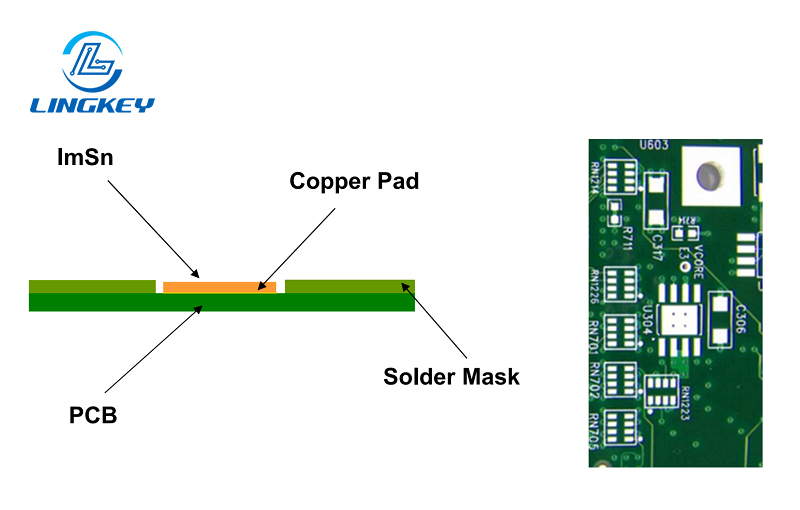
Immersion tin (ImSn) is a type of surface finish in which a pure tin layer is deposited on copper pads by a chemical displacement reaction. The layer of tin is effective in preventing copper oxidization and it also has very good wetting in solder, which results in a stable and reliable joint. Because of the high flatness and uniform thickness, it has been widely used for fine-pitch ICs and automated soldering.
Core Advantages of Immersion Tin
High Flatness
The immersion tin was very flat and smooth, no steps or rough textures. That’s why it is very well suited for high density packages like BGA, QFP etc. Its smooth tin layer provides enhanced stability and process-ability in automated soldering and fine-pitch routing.
Excellent Solderability
The pure tin finish has outstanding wettability which allows for quick, uniform and strong formation of solder joint while soldering. Since immersion tin yields consistent soldering results and can be repeated a large number of times, it is ideal for high volume production and for applications wherein the quality of soldering is required to be strictly controlled.
Nickel-Free Structure — No Signal Impact
Since immersion tin has no duct layer it does not add any additional signal loss or impedance mismatch in high speed high frequency applications. It is a preferred material for PCB designs which need signal integrity and low dielectric effect.
Excellent Copper Protection
The tin layer is an effective barrier to isolate copper from air and avoid oxidation, greatly improving the stability of PCB during transportation and storage. Better copper protection enables more controllable overall manufacturing, reducing soldering defects and increasing final yield.
Environmentally Friendly and Lead-Free
Immersion Tin is a fully lead-free, environmentally friendly surface finish that meets RoHS and other international environmental regulations. green manufacturing and lead free soldering in the electronics, immersion tin is still one of the best tried and true solution.
Limitations of Immersion Tin (Imm Tin) Surface Finish
Short Shelf Life
Immersion tin provides a free tin surface, which readily reacts with oxygen or sulfur based compounds in the atmosphere. Hence, it has less shelf life as compared to other surface finishes. If the storage conditions is not well controlled, the PCB surface may be slightly discolored and/or dull, which will affect the quality of soldering later. This means that immersion tin PCBs are more appropriate for applications in which the product is assembled in a shorter production cycle.
Risk of Tin Whiskers
Influenced by environmental conditions (high humidity, mechanical stress, electrochemical reactions, etc. The pure tin layer can grow tin whiskers. These very thin strands of wire can cause short circuits. High-reliability industries like automotive electronics, military, and medical device require special evaluation in the design stage and may be required to take additional preventive measures.
Not Suitable for Connectors or Wear-Prone Applications
Immersion tin is relatively soft and has poor wear resistance and so cannot be used on gold fingers, for plug-in connectors, key contacts, or in any application where it would be subjected to frequent mechanical friction. In comparison to ENIG or hard gold plating, immersion tin is not sufficiently robust so it should not be used in areas which demand a high contact reliability.
High Process Control Requirements
The copper surface preparation, cleanliness and tin-layer-thickness uniformity have to be extremely well controlled in the immersion tin process. Inadequate pretreatment or process control could result in poor solder joints, rough tin surface and (or) become the inconsistent soldering performance. Therefore a mature chemical management system and production surveillance are mandatory.
Common Application Fields
Immersion Tin is popular among many electronic manufacturing industry as the surface flatness is high and solderability is good. Typical applications are a wide range of consumer electronics, smart devices, computer motherboards, server boards, industrial control systems, automobile (non-plugging location) electronics, medical equipment and communication equipment.
As Immersion Tin has no nickel layer and provides stable soldering performance, it is best suited for PCB applications wherein high solder joint consistency is required but the joint will not be exposed to mechanical wear or subjected to frequent insertion/extraction. This is the reason for its preferencing for high-density assembly (HDI) and precision electronic products.
LingKey’s Immersion Tin Processing Capabilities
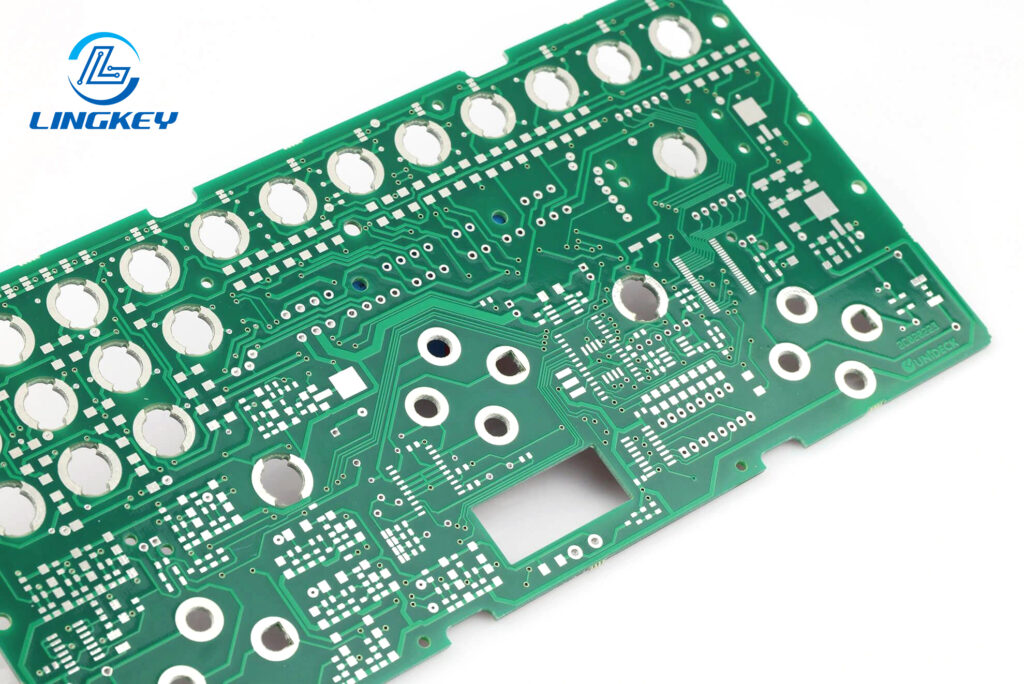
LingKey has well-established production technology for Immersion Tin (Imm Tin) which is both efficient and stable. With strict copper surface pretreatment, special tin-immersion chemistry system and tin-layer thickness control (0.8-1.2μm), we guarantee uniform soldering performance, good surface flatness and high-density design feasibility (BGA, QFN, QFP, HDI). All the materials and processes are fully compliant with the RoHS and REACH directives, giving your customers an environment friendly and dependable option for finishing their PCB surfaces.
During production, LingKey carries out full-process quality monitoring by AOI, X-Ray checking, flying-probe testing and other online testing methods to guarantee the electrical performance and the visual consistency. For prototype, small quantity or mass production, LingKey is able to provide reliable Immersion Tin PCB solution for the manufacturing needs of communication equipment, industrial control, automotive electronics and the like high density application scenario.