OSP
OSP, which stands for Organic Solderability Preservative is a clear organic layer that is applied to bare copper pads on a pcb. It is to protect copper from oxidation in the storage and assembly, also to have good solderability on reflow soldering.
OSP is popular because of the environmental-friendly, low cost and stable performance.
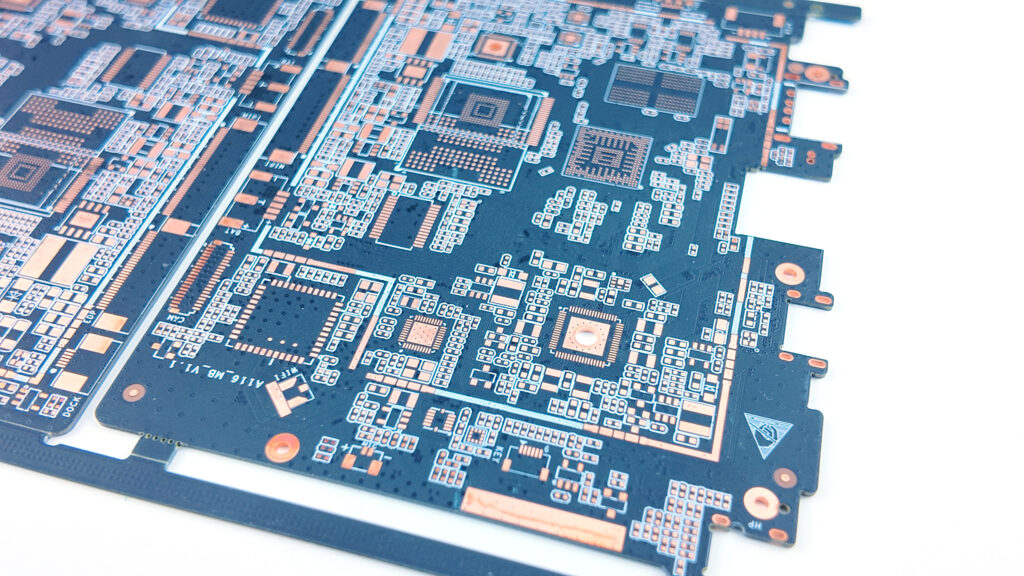
How OSP works?
1. Forming a Protective Organic Layer
OSP was applied through smearing a solution of tea polyphenols onto the exposed copper pads to form a thin and uniform organic layer. The layer also adheres strongly to the copper surface and acts as a barrier layer against moisture, contaminants, and environmental exposure during storage and handling.
2.Maintaining Solderability During Storage
The copper pads stay solderable after long storage or transportation due to the organic film. This helps maintain the roughness and wetting properties of the surface so that the PCB can be used for assembly when it is needed.
3.Controlled Removal During Reflow Soldering
During SMT assembly, the heat and flux of reflow soldering remove the OSP layer in a defined manner. Covering can be removed with OSP exposing a clean copper surface which will give strong metallurgic solder joints and no harmful residues.
4.Stability Across Multiple Processes
Contemporary OSP types are stable for processing at least three reflow cycles, minimal handling, and mild cleaning. This allows for use on high density SMT and complex PCBA assemblies without the risk of compromising the quality of the solder joints.
5.Precision Chemical Control
The chemical concentration, temperature, immersion time and copper cleanliness must be tightly controlled in the OSP process. A well-managed OSP process results in consistent film thickness, performance, and solder joint reliability for every PCB.
Key Advantages of OSP
1.Excellent Solderability
OSP offers a flat, consistent organic layer protecting the copper surface, which promotes good solder wetting in the assembly process. This contributes to the formation of strong, dependable solder joints on all types of PCBs.
2.Cost-Effective Process
OSP is quite easy and cost effective to apply in comparison to other surface finishes such as ENIG or HASL. Due to the minimal material and process costs, it is a cost effective solution for both prototype and production PCBs.
3.Environmentally Friendly
OSP is a lead-free, halogen-free with RoHS compliance surface finish. It omits the use of dangerous chemicals present in certain other finishes, enabling sustainable manufacturing.
4.Suitable for Fine-Pitch Components
The thin organic layer does not add any height to the pads, so OSP is well suited for high-density and fine-pitch SMT assemblies where accuracy and minimal pad variation are important.
5.Consistent Performance
With the correct chemical control, OSP can provide a uniform thickness with good protection to the copper. This provides predictable solderability and uniform PCB performance during storage, handling and assembly.
6.Compatibility with Multiple Reflow Cycles
Contemporary OSP coatings can support more than one reflow cycle, which enables the use of advanced assembly procedures involving many stages, without affecting the quality of the solder joint.
Limitations of OSP
1. Limited Shelf Life
The OSP coatings are responsive to environmental conditions including humidity, temperature and contamination. The organic protective layer deteriorates with time resulting in a decrease in solderability and possibly in the reliability of the final assembly. This renders controlled storage and timely use imperative.
2. Not Suitable for Multiple Reflow Cycles
Unlike ENIG or immersion silver, OSP is only good for a limited number of reflow soldering cycles. Each reflow wears or damages the OSP protective film and so this intermediate finish is not recommended for boards with double-sided SMT or complex assemblies that require multiple heating steps.
3.Surface Sensitivity to Handling
The OSP coating is very thin and can be removed by fingerprints, oxidation, dust and scratching. Soldering quality can be affected by any contamination on the surface and so OSP PCB boards need to be handled with care and have a well controlled process to prevent any defects.
4.Poor Contact Performance for Connectors
OSP-coated pads are not recommended for use in mechanical-contact situations (keypads, edge connectors, gold fingers). As OSP contains no hardness or wear resistance, the coating will be worn off in a relativelly short time after mechanical usage or abrasion.
5.Limited High-Temperature Reliability
OSP is more vulnerable to degradation than metal-based finishes in the long-term high temperature environment. In severe environments, the underlying copper surface can be oxidized by lengthy exposure which affects solderability and electrical performance, particularly in industrial or automotive applications.
6.Appearance Limitations
OSP finishes do not have the visual uniformity or brightness of finishes such as ENIG or immersion tin. This could be a disadvantage in case of high-end products or PCBs inspection where visibility of the surface is important.
LingKey OSP Manufacturing Capabilities
LingKey offers stable and dependable OSP (Organic Solderability Preservative) surface finishing which is designed to shield exposed copper pads and at the same time maintain uniform solderability during the delivery process in the whole SMT assembly process. With high-precision chemical control on automated production lines, we produce consistent, reliable, high quality OSP coatings for a wide range of PCB applications.
Our OSP process is performed within strict environmental and chemical controls. Each copper surface is micro-etched, activated and a controlled organic film is deposited ensuring an excellent level of surface cleanliness and protection against oxidation. This makes the PCB pads keeps the optimal solderability even after several reflow cycles and it is well worth for the cost-burdening and is recommended for large volume production, which OSP is suitable for the cost efficient, high volume manufacturing.
The facilities of LingKey enable OSP on single/double/multilayer PCB, HDI board and fine-pitch design. With a state-of-the-art inspection system for precision OSP thickness measurement and surface cleanliness determination, we guarantee that every PCB fulfills the requirements for immersion performance, wetting behavior, and long-term reliability.
From consumer electronics to industrial control, LingKey’s OSP solution offers a stable power-up and cost-effective surface finish that is RoHS compliant. Process know-how and stringent quality control inhibit the downstream assembly problems and also ensure good performance in every production lot.