PCB Manufacturing: Core, Prepreg Material & Multilayer PCB
Table of Contents
ToggleIntroduction
For those who are in pcb design and fabrication the knowing of what prepreg material is becomes imperative. Prepregs in PCB production are more than just layers of adhesive—they make it possible for PCB designers to push the limits in design, stack up multiple signal layers, and maintain PCB reliability. If you are working on a high-frequency RF board or a heavy-duty industrial multilevel, prepreg is an essential insulating material that basically decides the performance of the board. This is a comprehensive guide for prepregs, their characteristics, the prepreg vs core lawyer, best alternatives by app, and the most recent in the manufacturing technique for making high-quality PCBs.
In real-world PCB production, seasoned manufacturers like LingKey rely on their extensive understanding of prepreg material to enable complex stackups and still hold true to high production reliability and repeatability.
What is Prepreg in PCB Manufacturing?
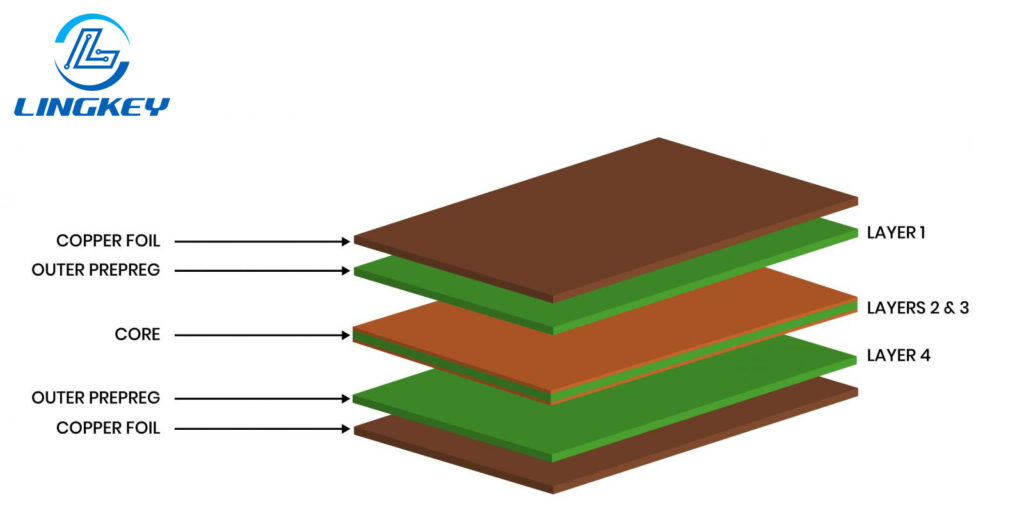
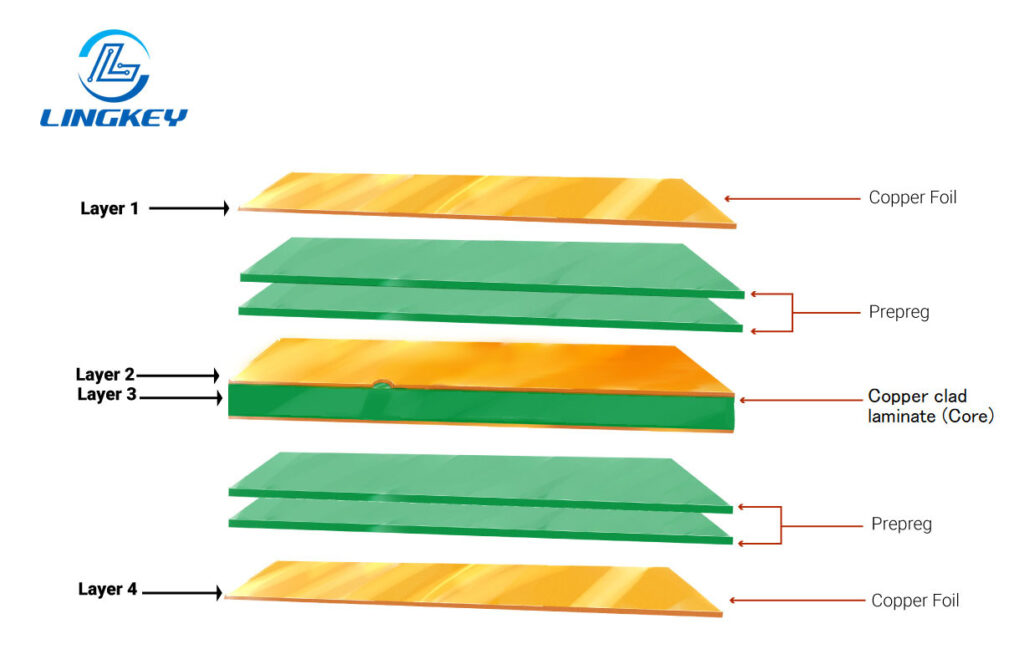
Prepreg is a reinforcement fabric, such as glass fiber, that has been impregnated with a resin like epoxy or polyimide. In PCB manufacturing, prepreg serves as a_heat_sealed partially-cured dielectric layer placed between copper-clad laminates (core layers) which is used to build up multilayer boards. This essential film is sticky and flexible prior to lamination, and during heating under press in the process of production the resin flows and fully cures which bonds several layers of PCB into a solid structure.
Conventional prepregs in PCB fabrication are made from either FR4 prepreg, polyimide prepreg, or other high grade materials. Their correct use enables PCB producers to customize the thickness, mechanical and electrical properties of their boards. Prepreg gives consistent insulation and mechanical strength, therefore it is used in stacking material of every multilayer PCB.
Why is Prepreg Essential for Multilayer PCBs?
Prepreg is vital in the production process of a multilayer PCB.It has a few important functions:
- Electrical Insulation:Prepregs separate the copper signal layers offering desired electrical isolation. This avoids circuits from shorting and allows high density, multi-layer routing in high-end PCB design.
- Mechanical Strength:Prepreg acts as a bonding agent and reinforces the PCB structure and contributes overall strength in the rigidity of the PCB structure. It helps to maintain the board flatness, as the number of layers in the PCB increases.
- Dimensional Stability:During the PCB processing, the prepreg resin prevents the layers from shifting or warping and also maintain stackup
- Controlled Dielectric Properties:Dielectric constant (Dk) of prepreg material is a function of its resin system and fiber weave and impacts impedance and signal integrity on high-speed circuits.
- Uniform Thickness and Planarity:Prepreg lamination process controls the thickness of the laminate stackup, which is essential for good bonding and packing for high-density advanced boards.
Prepreg enables the PCB fabrication process to be scaled up with multiple signal and ground layers, providing solid and high-performance multilayer designs.
Key Properties of PCB Prepreg Material
Selecting prepreg for PCB assembly should be based on the following material properties:
Property | Definition and Importance |
Dielectric Constant (Dk) | Influences signal propagation speed and impedance; lower is better for RF. |
Dissipation Factor (Df) | Measures energy loss in dielectric; minimized for high-frequency boards. |
Glass Transition Temperature (Tg) | The temp at which resin becomes rubbery; high Tg is needed for reliability. |
Resin Content and Flow | Means flexibility during lamination and prevention of voids or delamination. |
Thickness and Resin Content | Directly affects the thickness of the PCB, planarity, and layer adhesion. |
Moisture Absorption | Too much can cause voids in prepreg layers, reducing board reliability. |
These characteristics determine the prepreg quality and have to be matched with the required board performance, especially in high-end pcb design and manufacturing.
Types of Prepregs in PCB Manufacturing
The prepreg material is determined by the performance and cost requirements of your application. Here are the three that you are most likely to run into during PCB fabrication:
FR4 Prepreg
The standard material, FR4 prepreg is made of glass fiber reinforced epoxy resin. It has good mechanical strength, medium Tg and is cost effective. It is found in the production of the majority of consumer electronics, computers, and industrial control boards – a workhorse among different PCB types.
High-Tg Prepreg
High-Tg prepreg is processed to be stable at higher temperatures (Tg > 170°C). This prepreg is an essential part of boards that are subjected to severe environments, aggressive soldering procedures or automotive /industrial use. It provides high quality PCB assembly even at high pace of thermal cycling.
Low-Dk / Low-Df Prepreg
In the PCB design for RF and high-speed digital, the signal integrity is maintained with Low-Dk / Low-Df prepreg by reducing that loss and crosstalk. It is important to use it in high-speed circuits or telecommunications because even small losses could affect operation.
Polyimide Prepreg
Polyimide prepreg is the star when flex/flex-rigid PCB construction or extreme reliability is necessitated. It outperforms epoxy-base systems in high Tg, chemical resistance and life span.
Halogen-Free Prepreg
The halogen-free prepregs enable a green design and meet RoHS requirements, with the advantages of the normal resin systems.
Type | Common Use | Benefits |
FR4 Prepreg | Common PCB, general-purpose | Cost-effective, reliable, moderate Dk/Tg |
High-Tg Prepreg | Automotive/industrial | High-temperature stability, better for lead-free processes |
Low-Dk/Low-Df | High-speed, RF PCB | Superior signal integrity, low loss, controlled impedance |
Polyimide Prepreg | Aerospace/flex/rigid-flex | Excellent mechanical/chemical performance, very high Tg |
Halogen-Free | Green/consumer electronics | Eco-compliance, fire safety |
PCB Core vs. Prepreg in PCB Manufacturing
A critical element in understanding prepreg is knowing the difference between prepreg and core:
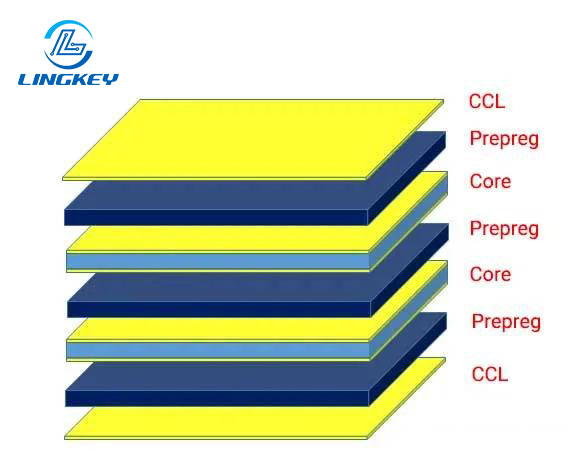
- Core in PCB:Solid rigid, fully-cured laminate, typically with copper cladding, used as the base material in pcb stack up It serves as the stable base for further build-up.
- Prepreg in PCB:The rubbery, partially cured resin/fiber sheet (usually glass fiber with resin) which bonds and insulates between the copper signal layers and core layers in the lamination.
Prepreg and core materials are therefore the building blocks that make up the backbone of any multilayer PCB. For the core, mechanical structure is provided, while for the prepreg, the bonding and insulating medium that affects the layers of the PCB assembly, the total board thickness, and ultimately the signal performance.
Role of Prepreg in PCB Stackup and Impedance Control
The pcb stackup—the ordering of the different layers of a pcb—depends greatly on appropriate layers of prepreg.Prepreg has multiple functions:
- Adhesion and Insulation:Prepreg is the adhesive that bonds the layers together and the dielectric that maintains the isolation of the signal layers.
- Controlled Impedance:By choosing an appropriate prepreg thickness and resin content the designers can precisely adjust the impedance of the signal layers, which is very important on high speed and RF circuit performance. In this manner, the prepreg material is a means to achieve better signal integrity and reduced crosstalk for multilayer pcb design and manufacture.
- Optimizing Stackup:The selection and positioning of the prepreg layers have an influence on the thickness of the board as well as on electrical and mechanical properties in the following layers of the PCB structure. For example, a thinner prepreg layer between two signal layers enables PCB designers to realize lower impedance, whereas thicker, or low-Dk, prepreg can be used to manage loss in microwave or ultrafast digital circuits.
- Reliability:Prepreg offers the mechanical reinforcement between core & signal layers that is required to help resist separation and cracking in normal and high-reliability applications.
Layer | Material Used | Function |
Top Layer | Copper Foil | Signal, soldering |
Prepreg Layer 1 | FR4 Prepreg | Insulation, adhesion |
Core Layer | FR4 Core | Structure, primary reinforcement |
Prepreg Layer 2 | Low-Dk Prepreg | Controlled impedance for RF |
Bottom Layer | Copper Foil | Ground/power or signals |
This is how materials are chosen for the PCB stack up to meet the performance, cost and reliability requirements of the above table.
Prepreg Manufacturing Process
The quality of the prepreg in the PCB manufacturing process is largely determined by the process of prepreg manufacturing. It involves a number of exact steps each of which affect the final board performance:
- Impregnation Process:Glass fiber (reinforcing material) is pulled through a resin solution— epoxy for standard resin or polyimide for high-end PCB manufacturing—with the resin content very tightly controlled.
- Drying and Partial Curing:The resin is a B-staged partially cured and has flexibility and a mild tackiness, the product will cure completely in the PCB lamination.
- Cutting and Packaging:Prepreg is sliced to the desired thickness of the board and stored to maintain its shelf life. The way you store prepreg is important; it’s usually refrigerated to avoid an unintentional full cure.
- Quality Testing:Uniform thickness and resin content were ensured—because thickness and resin content have a direct effect on the performance of the board.
The manufacturing process should be streamlined to yield consistent results in every run. Just like in a PCB, only high quality prepreg results in a clean, high-performance PCB.
How to Choose the Best Prepreg Material for High-Quality PCB Design
Material selection when choosing prepreg for PCB assembly depends on various criteria:
- Electrical Requirements:For highspeeds or RF boards, choose a prepreg material with a low Dk and Df.
- Thermal Performance:For automotive or industrial uses, a high-Tg or polyimide prepreg is preferable.
- Mechanical Needs:Flex and rigid-flex designs require tough, flexible polyimide or modified epoxy systems.
- Thickness of the PCB:The intended final thickness dictates which prepreg thickness and resin system to select- this is vital for reproducibility in multiple pcb production.
- Eco and Regulatory Compliance:If required, opt for halogen-free or RoHS-compliant materials.
Prepreg Selection Checklist
- Consult datasheetsfor dielectric and thermal specs.
- Match prepreg type and thickness to stackup and core.
- Factor in layers of the PCBand signal frequencies.
- Confirm compatibility with pcb fabricationpartner’s manufacturing process.
Practical Best Practices: Handling, Storage, and Layering
Optimizing reliability and manufacturability requires attention to prepreg handling and process:
- Store prepreg at refrigerated conditions according to supplier instructions. Exposure to room temperature should be minimized.
- Let the prepreg warm to room temperature in its sealed bag prior to opening to avoid moisture condensation and subsequent deterioration of the material properties.
- Work with the prepreg within its shelf-life duration for best resin flow during lamination.
- Reduce handling and wear gloves to prevent contamination that may affect board adhesion or insulation value.
- When stacking and layering, make sure that the prepreg sheets are properly positioned and cut to the PCB panel size without overlapping or leaving space.
Proper handling and storage are among the crucial factors to differentiate high quality PCB assembly which also guarantee the long term reliability of PCB.
Common Issues, Challenges, and Troubleshooting in Prepregs
Despite care, issues can arise with prepregs in PCB manufacturing:
Problem/Defect | Likely Cause | Solution |
Voids/Bubbles | Excess moisture or poorly cured resin | Ensure correct storage and process temp |
Delamination | Incorrect lamination cycle or contamination | Monitor temperature, pressure, and cleanliness |
Incomplete Cure | Inadequate heat/time in lamination | Adjust process parameters |
Thickness Variance | Inconsistent material or resin flow | Use high-quality supplier, check storage |
Electrical Failure | Wrong Dk/Df or layer misplacement | Review material specs, check stackup |
Frequent Questions about Prepregs in PCB Manufacturing
What’s the primary difference between prepreg and core in PCB fabrication?
Why does the thickness of a laminate matter?
Can I use different prepregs within a stackup?
What materials are usually used in the manufacturing of prepreg?
How does prepreg affect the performance and reliability of the PCB?
Industry Standards and Compliance for Prepreg Material
International standards guide prepreg quality and safety:
- IPC-4101: Covers prepreg and laminate specifications.
- UL 94: Describes fire-retardancy, particularly for finished PCBs.
- RoHS/REACH: Ensures environmental and health safety, especially with halogen-free options.
- Document control and traceability remain essential parts of the pcb manufacturing process.
Related Materials and Products Used in PCB Fabrication
- Copper foils and core laminates: Work in tandem with prepregs as part of the full stackup.
- Adhesive films: Sometimes used as an alternative or supplement to prepreg in certain assembly processes.
- Solder masks, finishes and other layers in a PCB are also important in the overall processing of a multilayer board.
Conclusion
Prepreg is an essential element in making up the multilayer pcb design modern, robust and reliable. By appropriate material selection, handling best practices, and consideration for manufacturing process requirements, prepreg layers provide PCB engineers a means to address the electronic challenges of today – and tomorrow. If you’re developing new manufacturing techniques, ramping pcb production, or tweaking next-generation high-speed hardware, knowledge and optimization of prepreg is the difference between a run-of-the-mill and a world-class circuit board.
With the support of professional PCB fabrication partners like LingKey, the optimized prepreg and stackup design can turn advanced ideas into reliable, multiclayer PCB that can be mass produced.